Mark Carney as Prime Minister shares many things with his predecessor, Justin Trudeau, one of which is the way that both of them contradict their own fathers when it comes to the Aboriginal issue – despite the fact that the fathers knew far more about the subject than their foolish, virtue-signaling sons…
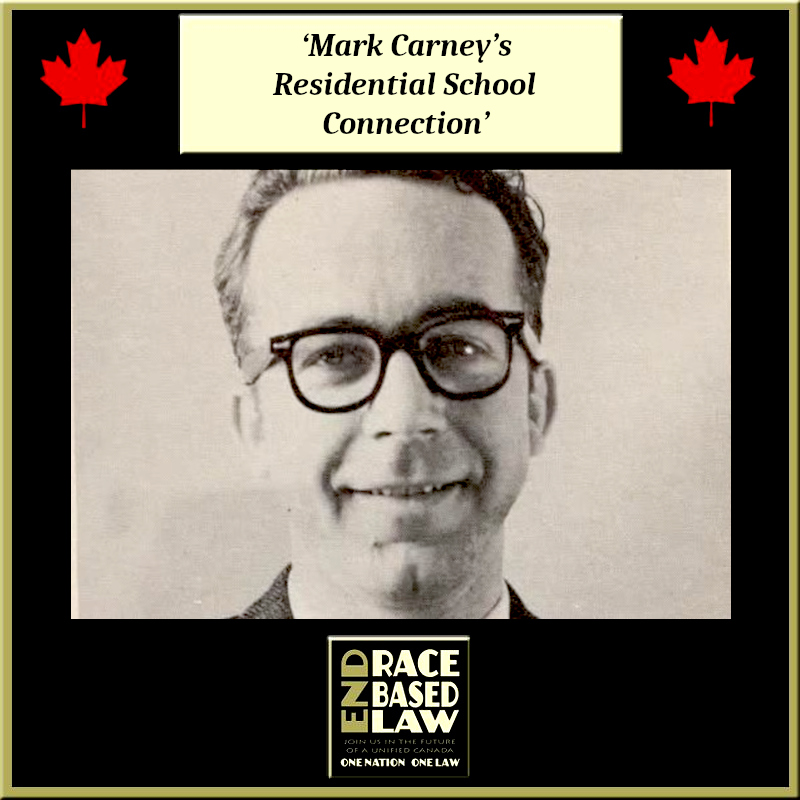
“‘Liberal’ {Party} Leader Mark Carney distanced himself from comments his late father made 60 years ago as an educator that were dismissive of some ‘Indigenous’ {sic, Aboriginal} people, and his subsequent defence of residential schools in the later years of his life.
“I love my father, but I don’t share those views, to be absolutely clear“,
Carney said at a campaign event in Oakville, Ont.
“He was responding to coverage by {the Segregated} CBC ‘Indigenous’ and other media about comments made by his father, Catholic educator Robert J. Carney, who died in 2009.
“During a 1965 ‘CBC Radio’ interview {See below}, the elder Carney spoke of a program at an Indian day school in Fort Smith, N.W.T., where he was principal, for “culturally retarded children“. He defined such a child as one “from a Native background who, for various reasons, has not been in regular attendance in school“, or a student with a non-English-speaking background who is behind in their studies.
“His views reflected the assimilationist {integrationist} attitudes commonplace in Canadian society at the time, particularly among educators, {Aboriginal Industry} ‘historian’ Jackson Pind {a part-Aboriginal} told CBC ‘Indigenous’.
{“He is currently an assistant professor of ‘Indigenous’ Methodologies at the Chanie Wenjack School of ‘Indigenous’ Studies at Trent University”.}
“In a 2019 settlement, the federal government acknowledged the Indian day school system divided children from their families, denied them their heritage and subjected many to physical, emotional and sexual abuse.
{Day schools were regular schools on reserve where the children went home every night. How was that ‘dividing children from their families’? Like so much about this issue, emotion continually overrules common sense and historical reality – and politicians are some of the worst offenders…}
“Carney’s father went on to hold various positions {See below} before becoming a university professor. In a 1991 church-commissioned study, he interviewed 240 former residential school students, eventually reporting allegations of extreme physical abuse and 15 alleged instances of sexual abuse at eight western Arctic residential schools.
“He acknowledged the abuse in his report, saying these students had been “scarred“. But in later comments, he stressed a number of the interviewees had had positive experiences and the work of educators “cannot be viewed as being wholly destructive or ill-intended”.
{If there were 15 ALLEGED sexual abuse cases out of 240 students, what else was he supposed to conclude? In addition, as a former principal of one of those schools, he was far more familiar with the reality than this reporter…}
“He later criticized ‘Indigenous’-led studies highlighting the negative effects of these schools as one-sided and imbalanced {Which they most certainly were – and are…}.
‘Schools caused ‘fundamental damage’
“On Saturday, Mark Carney said residential schools and Indian day schools are a “long, painful part of our history“.
{Speaking of “one-sided and imbalanced”, that comment is typical of the one-sided rhetoric of the ‘Liberal’ Party.}
“He said he and the country has learned of the
“fundamental damage of residential schools and day schools to {a small minority of} those who attended them [and] those who were their descendants“.
“Advancing ‘truth’ and {One-way} reconciliation, he explained, was a core element in his brief tenure as prime minister…
“That is a fundamentally and deeply-held personal commitment of mine.”
{Why? And what have you EVER done about it before?}
“Historians {Which ones?} say it’s unclear if Robert Carney’s views {d}evolved after the report from the 1996 Royal Commission on Aboriginal Peoples was released.
{Now that’s just an ignorant statement, considering that Robert Carney wrote a lengthy criticism of the one-sided RCAP report where Residential schools were concerned – see below.}
“In 2006, the government reached a settlement with residential school students. Carney died three years later.”
–‘Carney distances himself from late father’s views of Indigenous children, residential schools’,
Ian Froese, CBC News, Apr. 05, 2025 | Updated: April 08, 2025
FEATURE Image: Facebook/Memories of Fort Smith NT/Priscilla John Cole
What a phony – VIDEO:
https://www.cbc.ca/player/play/video/9.6713190

“The 2025 Canadian federal election campaign is in full swing. During such times, extra attention is paid to candidates and Party leaders, which can sometimes include digging up stories about their pasts, which is fair game. But on Thursday, CBC went further than most, resurrecting the ghost of Robert Carney to stand trial for using “outdated language” in a 1965 interview and his nuanced {educated} defense of the residential school system.
“But Robert Carney is dead, and can’t defend himself. So, it appears the real reason CBC did this was to call out his son, ‘Liberal’ {Party} Leader Mark Carney, to “speak out and address his father’s legacy”.
{Which segregated Aboriginal media had already tried to do, to no avail – See below.}
“The CBC story suggests that ties that Robert Carney — a Catholic educator and federal day school principal — had to a Day school in Fort Smith, N.W.T., need to be “untangled” {?}. It provides readers with statements from {only Aboriginal Industry} ‘historians’ and others to suggest he has an “assimilationist” attitude and this legacy is one of residential school “denialism”. The CBC makes an anachronistic assertion using an interview from 1965 to suggest that the elder Carney should have known back then that the term “culturally retarded” would be offensive in 2025, 60 years later.
“But the attempt to smear the elder Carney backfired. What Carney’s writings and the interview provided actually suggests is that Robert Carney was a good man, genuinely concerned with both the education of ‘Indigenous’ {sic} children and the maintenance of their cultural pride. There are no allegations that the late Carney ever harmed an ‘Indigenous’ student {Quite the opposite}. As an educator and principal, he appears to have been beyond reproach.
“In fact, he brought to light instances of abuse within residential schools (which were different than the day school he personally worked in). He interviewed 240 former residential school students for a 1991 church-commissioned study, and according to CBC,
“report(ed) instances of extreme physical abuse and 15 alleged instances of sexual abuse at eight Western Arctic residential schools”.
“The CBC story includes a 1965 interview with Robert Carney about his progressive school program that CBC suggests some might find “jarring”.
{The CBC always tries to bias the response to these stories…}
“The interviewer opens:
“Mr. Carney, at the teacher’s conference not long ago, you told about a program you have working at the Joseph B. Tyrrell (JBT) school in Fort Smith for culturally retarded children. First of all, would you define a culturally retarded child for me?”
“The word “retarded”, which was used frequently in books and articles at the time of this interview, has since been retired from modern discourse, but for CBC to pretend that the elder Carney here meant anything other than delayed, and not permanently, but temporarily, is a {deliberate} smear.
“Robert Carney goes on to explain a term that didn’t seem to shock the interviewer who used it herself — an interviewer from CBC, of all places. Miraculously, the 1965 CBC interviewer escaped the call out to her children to answer for her sin of being complicit in using the same term.
“A culturally retarded child in the context of the Northwest Territories is a child from a Native background who for various reasons has not been in regular attendance in school”,
said Carney.
“He’s from a language background other than English and who is behind in school, say three or four years. In many centres in southern Canada, the subculture groups, say in the working-class area of a large city, you would have children who you would call culturally retarded.”
“By his own explanation, he used the term to explain that, when a child is not attending school regularly, which was often the case even in working classes at the time, their learning progress (adoption of culture) was held back. No implication was made about their cognitive ability.
“The elder Carney goes on to explain that the programs he was working on at the time were developed to “meet their needs, to try and upgrade their skills and bring them into contact with the dominant culture” {Which is exactly what the Chiefs, during Treaty negotiations, were asking for}. This would have been, in Carney’s mind, and anyone at the time who believed that all students in Canada should go to public schools for an education, the right thing to do. Attaching malevolence to this goal is a luxury of future judges.
“Carney explained to the CBC host why he believed these programs were needed, that many of the students coming to the schools from northern communities were
“behind in school three, four, five, and six years”,
he said.
“So we established a number of classes, which we have given the name special classes for want probably of a better word, and these classes are structured in such a way that the academic skills that are so important, to any child living in the 20th century, that these skill are taught in an appropriate manner.”
“People may also bristle at Carney’s use of the word “special” here, but it’s clear no harm was intended. Carney stressed that only those children who were significantly behind would be in the special program, and would be transferred to the regular one as soon as they were ready, and that many Indigenous children were, in fact, in the regular program.
“Elder Carney’s educational program was progressive in many ways. He wasn’t even a fan of using the word “grade” and instead preferred transferring students as soon as they reached a new level, letting a child move at their own pace. He was very proud of the fact that he realized a ratio of one teacher to fifteen students as opposed to one to forty in other schools was preferential for both the students and teachers. He also believed that a teacher should be a specialist in a subject rather than a generalist.
“Listening to the elder Carney’s tone and goals, I’m reminded of a speech Mr. Rogers gave in 1969 to the U.S. Senate Commerce Committee, requesting funding for his show and public broadcasting. Like in Mr. Roger’s speech, Carney’s passion for children’s education in the 1965 CBC interview was palpable.
“Carney told the interviewer:
“We want them to be able to read. We want them to be able to speak English. We want them to be able to do the various operations in arithmetic. We want them to know about the world. We want them to know about the world of science. We want them to have the opportunity of expression in music and art. We want them to learn various skills in physical education and so on”.
{That’s what’s now labelled ‘colonial oppression’ and ‘cultural genocide’…}
“Carney was adamant that the students keep their ‘Indigenous’ pride, but not that they stay in the day school system:
“But at the same time, we want them to not forget their origins, or not to forget their backgrounds, and to instill in them a sense of pride and a sense of belonging that the culture from which they come is a good culture, and if they do go back to the old way of life, they go back with skills which will help them in the old way of life”.
“Despite Carney’s beliefs stated in the interview, CBC’s Thursday story cites Trent University’s {Aboriginal Industry ‘historian’} Jackson Pind, referring to Carney’s views as “assimilationist” {Ironically, assimilating is how Pind got his job and career.}. The CBC links to a blog Pind and two other historians wrote about Carney’s “legacy” which they suggest includes “residential school denialism” {The latest Aboriginal Industry propaganda label}, a term which they define as “the twisting, downplaying, or minimizing of truths related to residential schooling to protect church and state and the ‘colonial’ {‘modern’} status quo”.
“Despite noting that Carney “earned a PhD in Educational Foundations from the University of Alberta”, “wrote many articles about the history of schooling in the Northwest Territories”, and “served on the editorial board of the ‘Canadian Journal of Native Education’” – actions most reasonable people would attribute to someone genuinely well-meaning and interested in ‘Indigenous’ education – the ‘academics’ suggest Carney’s motivations were questionable.
{These are propagandists, not academics. They only use the academy for a legitimacy that they don’t deserve and are usually there as a result of ‘Indigenous’ Race quotas for faculty.}
“Carney, you see, as a professor and department chair, “often spoke positively about Indian day and residential schools”. This, no doubt came from his own lived experiences.
“These ‘professors’ suggest this Mr. Rogers-like educator’s problematic nature didn’t end there. They suggest he should not have criticized a book titled, “Resistance and Renewal: Surviving the Indian Residential School”, by Celia Haig-Brown that they refer to as “ground-breaking”. Carney’s criticism: It focused too much on trauma. They do not mention whether he had anything positive to say about the book.
“Most of all, the ‘historians’ whose blog CBC linked,
https://activehistory.ca/blog/2025/04/03/robert-carney-residential-school-denialism/#more-41652
appear to be most concerned with Carney’s review of the Royal Commission on Aboriginal Peoples’ report
suggesting that Carney “dismissed” it when he criticized it as “being one-sided” {Which it most assuredly was!}. They complained that Carney’s
“sentiments were in opposition to what ‘Survivors’ {The Aboriginal Industry’s pejorative term for ‘former students’. The Industry likes to pretend that they all were ‘survivors’ of schooling} were telling Canada about their experiences of being institutionalized at residential schools”.
“But if you read the review, Carney does no such thing. He just highlights what’s missing in terms of context, which could, very well, in a scholarly-distanced tone, seem cold to some. Here’s what he does say:
“This is clearly a slanted account of these institutions {!}, and therefore should be viewed cautiously because, to cite one of its problems, it tells only part of the story.”
“He continued,
“The phenomenon of Aboriginal residential schooling is too complex and requires considerable nuance”.
He was right.”
–‘CBC unfairly attacks Carney’s father’,
Terry Newman, National Post, Apr. 04, 2025 / Updated Apr. 08, 2025
https://nationalpost.com/opinion/terry-newman-cbc-unfairly-attacks-carneys-father

“Former students of a federal Indian day school in the Northwest Territories say they remember Robert Carney from his time as principal there in the 1960s. Robert was the father of Prime Minister Mark Carney. He died in 2009.
“He was my principal, he was great”,
said Frieda Martselos, who attended Joseph Burr Tyrell (JBT) school in Fort Smith, a town in the southeastern part of the northern territory, near the Alberta border.
“I don’t have any negative stories”,
added Martselos, who is a former Chief of Salt River ‘First Nation’ {a ‘nation’ of 1,067 people}, 100 kilometres southeast of Fort Smith, and a former MLA for the area.
“Everyone who went to school with me there have done very well in their lives.”
“A post going viral on Facebook about the senior Carney’s position is being met with shock and dismay {By whom?}. Some commenters claim the clipping from the school’s 1963 yearbook is false.

“But ‘survivors’ like Martselos confirm the information is true.
{She’s a former student and calling her a ‘survivor’ is just plain stupid…}
“She was one of an estimated 200,000 ‘First Nations’ {Indians}, Inuit and Métis children to attend the government-sponsored religious and assimilationist {integrationist} institutions. The national school system started up in the late 1800s and operated until the late 1900s.
“Robert ran JBT – first known as Fort Smith Federal Day School – for several years. Mark was born in Fort Smith. Mark is a former governor of the Bank of Canada and Bank of England, who recently became Canada’s national ‘Liberal’ Party leader and prime minister after Justin Trudeau stepped down in March. He was previously an economic advisor to Trudeau.
…
“Michael Miltenberger, another former MLA for Fort Smith, says Mark’s father was the principal when he was a student there in 1963. He says non-‘Indigenous’ children like him were sent there, too.
“There was no other place for us to go”,
he told APTN.
“There was a plane-load of us that came down to Breynat Hall, which was run by the (Catholic missionary) Oblate (priests) for the government.
“Mr. Carney was there; I was just a little guy – like, 13”,
Miltenberger added.
“I didn’t have too much interaction with the principal, because to go down to the principal’s office wasn’t usually good news.”
{Like in any school…}

“Breynat Hall, according to the National Centre for ‘Truth’ and Reconciliation (NCTR), was part of a Canadian government project in the mid-1950s to build day schools and student hostels in larger northern communities. Canada transferred control of the hall to the territorial government in 1969 while the church continued to run it.
“Like Martselos, Miltenberger says he has good memories of the place where he completed high school at age 18. He noted a number of prominent people in the N.W.T. were his classmates.
“(Former Premier) Bob McLeod, (former MP) Ethel Blondin-Andrew, (former Premier) Stephen Kakfwi… There’s so many of us that went at the same time that all went on to be professionals, politicians, chiefs, national chiefs, premiers, (government) ministers”,
Miltenberger said.
{Such a horrible school, full of ‘survivors’…}
…”
‘Mark Carney’s dad was the principal of an N.W.T. day school: survivors’,
Kathleen Martens, APTN, Apr. 03, 2025

“Mark Carney is dodging ‘Indigenous media’ — but why?
“Could it be because his father’s legacy as an Indian day school administrator and historian, who documented both the good and the bad he witnessed in the residential school systems, doesn’t fit today’s politically-correct narrative or the growing calls to criminalize so-called ‘residential school denialism’?
“Despite his recent pledges of millions of taxpayer dollars toward the country’s ongoing {one-way} ‘reconciliation’ initiatives, the newly-sworn-in Prime Minister has avoided speaking with Canada’s ‘Indigenous’ broadcaster.
“Prime Minister Mark Carney has committed an additional $253 million in economic support across Nunavut; yet, refuses to engage with APTN News, the world’s first {segregated} ‘Indigenous’ national broadcaster.
“According to APTN, Carney
“declined a one-on-one interview request with APTN News and was the only leader to turn down an opportunity to answer six written questions by the network to him by email”.
“The network also reported that during the ‘Liberal’ {Party} leadership race, Carney’s team failed to respond to their media requests.
“Although Carney hasn’t explained his reluctance to engage with ‘Indigenous’ {Aboriginal} media, his silence may reflect the delicate balance he must strike — navigating Leftist accusations of “residential school denialism” while protecting his father’s legacy and family reputation.
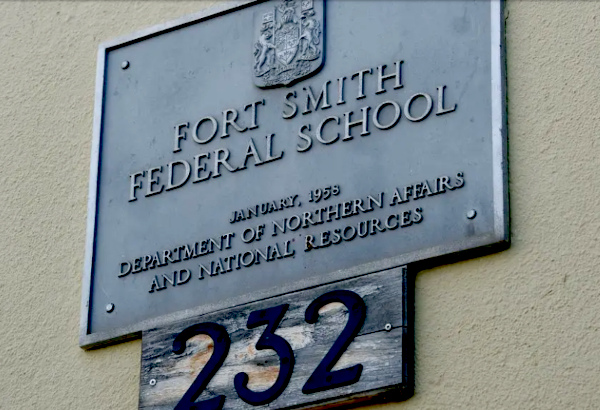
“Robert J. Carney, Mark Carney’s father, wasn’t just any educator, he was a principal at the Joseph Burr Tyrrell Elementary School, in Fort Smith, Northwest Territories when it was a federally-run Indian day school. The school, which still stands today, is considered a former residential school by its community.
{But that’s silly. ‘Day schools’ were just ordinary community schools, where students went home every night, while ‘Residential schools’ were live-in institutions…}
“Far from ashamed, R. Carney also spoke proudly of his work there, calling it “part of the greatest investment of Northern endeavour” in a message published in the school’s yearbook, ‘The Borean’.
“We live in a small community in Canada’s North, whose very future is dependent on the educational processes that are being carried out in its schools {!}”,
he wrote.
“So vital is the educational process, and so important its result, that it goes without saying that every citizen of the Northwest Territories is vitally interested in the work of such a school as ours.”
“That sentiment was far from isolated. Robert Carney, who also served as the Chief of School Programs for the Northwest Territories before resigning in 1971, later went on to become a respected historian and professor at the University of Alberta. He was appointed Acting Director of the Department of Indian Affairs for the Province of Alberta in 1976.
“In R. Carney’s review article on the ‘Royal Commission on Aboriginal Peoples’, he noted that while the schools were far from perfect, they did more than just provide education. Some schools took in sick, orphaned, and abandoned children and even provided shelter for adults in need. He argued,
“The schools were an important resource for the northern and isolated regions, offering shelter, food, and a stable environment for children in need. While not free from criticism, they played a significant role in the development of the region”.
“That’s a far cry from the “genocide” label that our House of Commons unanimously accepted in 2022
https://endracebasedlaw.wordpress.com/2023/10/13/a-virtue-signalling-lie/
or the push from voices like {Aboriginal} Kimberly Murray—the ‘Independent Special Interlocutor for Missing Children and Unmarked Graves’, NDP {Aboriginal activist} MP Leah Gazan, and lobbyists with the ‘First Nations’ {Indian tribes} Leadership Council—who are calling to criminalize the speech of those they deem as “residential school deniers” or “minimizers”.
“His balanced, contextual documentation of the residential school system has put him at odds with the current narrative, which, following the Kamloops ‘First Nations’ false claim to have discovered the remains of 215 children in unmarked graves at the former Kamloops Indian Residential School,
https://www.rebelnews.com/kamloops_the_buried_truth
has led to several prominent professionals who dared to echo similar facts being cancelled.
“Some examples include Ron Paull, the Mayor of Quesnel, B.C., who was censured in 2024, banned from meetings and entering ‘First Nation’ land in his own community
https://endracebasedlaw.com/2024/05/10/book-banning-in-quesnel
after his wife recommended a few people read “Grave Error”—a book of historical residential school facts that acknowledge some of the good things that occurred in the system, including at the former Kamloops Indian Residential school.
https://endracebasedlaw.com/2024/12/04/grave-error/
“Paull was vindicated this year after the Supreme Court ruled that his colleagues punished the mayor arbitrarily.
https://canadiansforlegalequalityblog.wordpress.com/2025/04/25/book-banning-in-quesnel-update
“Similarly, Frances Widdowson, a tenured professor at Mount Royal University, was dismissed in December 2021 for highlighting the educational benefits of residential schools alongside their harms, a firing an arbitrator later deemed “disproportionate” in 2024.
“Just last month, Vancouver-Quilchena MLA Dallas Brodie was expelled from the B.C. ‘Conservative’ {Party} caucus
for pointing out that, contrary to widespread residential school misinformation—including within the Law Society of B.C.’s mandatory ‘Indigenous’ Intercultural Course
https://endracebasedlaw.ca/2025/03/14/lawyer-vs-law-society-kamloops-graves-libel/
—in reality, zero bodies have been discovered at the former Kamloops Indian Residential school nearly four years and millions of tax dollars later.”
–‘Mark Carney’s father ran an Indian day school. Does this explain his silence with Indigenous media?’,
Drea Humphrey, Rebel News, March 26, 2025

“It was March 1965, and Catholic educator Robert J. Carney had gone on CBC Radio to discuss his work as a federal day school principal in the Northwest Territories. Today, it’s an interview some may find jarring.
“Mr. Carney, at the teachers conference not long ago, you told about a program you have working at the Joseph B. Tyrrell (JBT) school in Fort Smith for culturally-retarded children“,
the host began.
“First of all, would you define a culturally-retarded child for me?“
“The reply was unequivocal and direct.
“A culturally-retarded child in the context of the Northwest Territories is a child from a Native background who for various reasons has not been in regular attendance in school“,
said Carney.
“He’s from a language background other than English and who is behind in school, say three or four years. In many centres in southern Canada, the subculture groups, say in the working-class area of a large city, you would have children who you would call culturally retarded.”
https://www.cbc.ca/player/play/video/9.6710358
“Sixty years later, ‘Liberal’ {Party} Leader Mark Carney’s father is generating debate among ‘First Nations’ people. Posts circulating online have incorrectly called him an Indian residential school principal. While that’s false, it’s true that the Joseph Burr Tyrrell school was officially recognized under a 2019 class-action settlement as a federal Indian day school between 1948 and 1969, when it was transferred to the territory.
https://indiandayschools.com/en/wp-content/uploads/schedule-k.pdf
“And it’s also true that ‘Indigenous’ children from Fort Smith’s Grandin College and Breynat Hall residential schools attended the day school during Carney’s principalship, which began in 1962, according to his thesis and historical records reviewed by CBC ‘Indigenous’.
https://archive.org/details/Carney1971/page/n5/mode/2up
“The school in question was a combined {integrated} school“,
said Crystal Gail Fraser, who is ‘Gwichyà Gwich’in’ {An Indian tribe, 507 people} and an associate professor in history and ‘Indigenous’ studies at the University of Alberta.
“You had this mix of ‘White’ {European} settler kids and ‘Indigenous’ kids who lived in Fort Smith, plus all of the children from Breynat Hall, the residential school nearby.“
“Along with historians {Aboriginal Industry activists} Jackson Pind and Sean Carleton, Fraser co-authored an article in the blog ‘Active History’ this week about Robert Carney’s legacy. They told CBC ‘Indigenous’ that much remains unknown about day schools — Fort Smith’s federal school records remain restricted at the national archives in Ottawa, for instance — rendering the full truth elusive.
“We’re trying to have these discussions in productive ways that don’t harm ‘survivors’ as we get to ‘the truth’,”
said Pind, an assistant professor at Trent University’s Chanie Wenjack School for ‘Indigenous’ {sic} Studies.
“Looking at our legacy as Canadians, we’re all kind of tangled in this web of ‘colonial’ {modern} schooling, both ‘Indigenous’ people and non-‘Indigenous’ {Everybody else} people.”
{NOTE: DNA shows that Canadian Aboriginals are ‘Indigenous’ to Siberia and Mongolia – in the case of the Inuit, relatively recently.}
‘Untangling the web’
“Carney’s comments in the radio interview reflect assimilationist {integrationist – Remember Martiin Luther King?} attitudes common in Canadian society in 1965 generally and among educators specifically, said Pind, who has mixed Settler-Anishinaabe ancestry from Alderville ‘First Nation’ {a ‘nation’ of 1,386 people}.
“That’s obviously a very harmful comment“,
he said, noting teachers then also commonly described their ‘Indigenous’ pupils as “backwards“.
{In terms of their adaptation to the modern world, they were…}
“In the 2019 settlement, Ottawa acknowledged the Indian day school system divided children from their families {? They went home every night – like most Canadian children!}, denied them their heritage {? The school never stopped their families from passing on their heritage, like most Canadian immigrant families did} and subjected many to physical, emotional and sexual abuse {Like religious schools did to many other Canadian children}.
“Later in the radio interview, Carney says,
“We want them to not forget their origins, or not to forget their backgrounds and to instill in them a sense of pride and a sense of belonging: that the culture from which they come is a good culture“ {!}.
“Robert Carney may indeed have left a complicated legacy, the ‘historians’ said. As a divisive election heats up, they were quick to argue the father’s sin should not be laid on the son — but they also said Mark Carney should still speak out and address his father’s legacy.
“A ‘Liberal’ {Party} spokesperson did not do that directly in a provided statement.
“The residential and day school systems are an undeniably painful chapter {for some} in our country’s history, with real harms that last to this day. In his first weeks as prime minister, Mark Carney has taken important steps to ensure that advancing {one-way} ‘reconciliation’ is a foundational commitment of our new government“,
wrote Jenna Ghassabeh.
“A Carney government would be informed by ‘Indigenous perspective’ to understand these deep and lasting injustices and commit to the important work outlined by the {Aboriginal} ‘Truth and Reconciliation’ Commission, she added.
‘From principal to scholar’
“Robert Carney became chief superintendent of schools in N.W.T. from 1969 to 1971. From 1973 to 1975, he was executive director of the Northern Development Council of Alberta. He was acting director general for Indian Affairs in Alberta in 1976.
“In a 1991 church-commissioned study, Carney interviewed 240 former residential school students, eventually reporting allegations of extreme physical abuse and 15 alleged instances of sexual abuse at eight Western Arctic residential schools.
“There is no doubt whatsoever that they have been scarred by what was done to them or by what they had witnessed“,
the then-professor at the University of Alberta told the ‘Canadian Press’.
“But after the papers published explosive headlines about priests and rape, Carney clarified that, in his view, it wasn’t just an “abuse report“. He wanted to focus on the good {Because that was the case for most students}.
“A number of interviewees expressed positive comments about their experiences in residential schools and hostels, while others deplored what they described as the excessive attention given to negative incidents related to these institutions“,
he wrote to the ‘Edmonton Journal’.
“Sean Carleton, a settler historian {taxpayer-funded Aboriginal Industry activist} and associate professor at {racist} University of Manitoba, echoed the need to grapple with Robert Carney’s role in and defence of this system without descending into partisanship {Carleton only knows ‘partisanship’}.
“We can learn about Robert Carney’s complicity {See?]in this system. We can challenge his comments defending residential schools as ‘denialism’. We can press Mark Carney to do better on ‘truth and reconciliation’,”
said Carleton.
‘On early schools and RCAP’
“After the church study, Robert Carney went on to argue much of what pre-Confederation missionaries did concerning ‘Indigenous’ schooling
“was intended to help Native people to adjust to a changing environment“ {!}.
“Those who ‘came to teach’ European values and skills to aboriginal people during the period […] often failed to achieve their objectives“,
he wrote in 1995,
“but their efforts in this regard cannot be viewed as being wholly destructive or ill-intended.”
“The paper is typical of the era, said Mary Jane Logan McCallum, professor at University of Winnipeg and Canada Research Chair in ‘Indigenous’ People, History and Archives {And also an Aboriginal Industry activist}. She was a student at the time and remembers being assigned articles like Carney’s. It was also time when lawsuits were hitting churches, “which made for more of this kind of apologist {realist} backlash“, she said by email.
“We know now and Canadians knew then that the schools were purposely underfunded by churches and by the federal government; we know that due to this, there was suffering“,
wrote McCallum, a member of the Munsee-Delaware ‘Nation’ {a ‘nation’ of 739 people}.
“We know that the schools intentionally played a role in cultural destruction and ‘linguicide’ {?!?}. We know there is a need for reparations both for the past {?} and in terms of our current relations {? You’ve done pretty well} and so it matters that our prime minister engages with this central question.”
“Carney’s scholarship on this topic continued. He criticized the sweeping 1996 ‘Royal Commission on Aboriginal Peoples’ as one-sided and imbalanced.
{Which it most certainly was:
https://canadiansforlegalequalityblog.wordpress.com/2019/02/01/rcap-and-the-fragmentation-of-canada/ }
“The problem is that the Aboriginal perspective dominates virtually everything that is said {!}“,
Carney wrote. Consequently, he added,
“Aboriginal residential schools are invariably cast in an unfavourable light“.
“This is clearly a slanted account of these institutions, and therefore should be viewed cautiously because, to cite one of its problems, it tells only part of the story.”
“Pind called it frustrating to see a non-‘Indigenous’ person criticizing the first major ‘Indigenous’-led report examining relations with the State as “slanted” because it comes from an ‘Indigenous’ perspective.
{And ONLY “an “‘Indigenous’ perspective”. THAT’S “slanted”!}
“It remains unclear, the ‘historians’ {activists} said, whether Robert Carney’s views {d}evolved after this, when the Indian residential schools settlement was reached in 2006. He died in 2009, in Nanaimo, B.C.”
–‘Untangling Mark Carney’s father’s ties to Fort Smith, N.W.T., Indian day school’,
Brett Forester, CBC News, Apr. 03, 2025
(Brett Forester is a reporter with {segregated} CBC ‘Indigenous’ in Ottawa. He is a member of the Chippewas of Kettle and Stony Point ‘First Nation’ in southern Ontario {a ‘nation’ of 2,663 people} who previously worked as a journalist with the {segregated} Aboriginal Peoples Television Network.)
https://www.cbc.ca/news/indigenous/robert-carney-jbt-day-school-1.7501066
Excerpts from Robert Carney’s review article on the ‘Royal Commission on Aboriginal Peoples’:
“One of the tasks addressed by the Royal Commission on Aboriginal Peoples (RCAP) was to chronicle the origins and characteristics of Native residential schools. But the phenomenon of Aboriginal residential schooling is complex and requires considerably more nuance, as well as conceptual analysis, than the simplistic historical interpretations offered in this {RCAP} document.
…
“The thesis is that Aboriginal people should achieve equal status with other Canadians and that this should occur not by a process of integration, but rather by means of separate and parallel institutions negotiated on a nation-to-nation basis.
{But they are not a ‘nation’ and never were…and equating what were mostly extended families with modern nations is simply ludicrous in the extreme…}
“The problem is that the Aboriginal perspective dominates virtually everything that is said {And still does}. This is not surprising given that the linear perspective has been defined in such a way to exclude it from the analysis. As a result, Aboriginal residential schools are invariably cast in an unfavourable light. Whenever the schools are mentioned, they are found almost without exception to have failed to provide either acceptable care or education. The schools’ objectives, policies and practices are identified as a systematic strategy of cultural repression which was accompanied by an extraordinary amount of sexual, physical and emotional abuse. This is clearly a slanted account of these institutions, and therefore should be viewed cautiously because, to cite one of its problems, it tells only part of the story.
“The phenomenon of Aboriginal residential schooling is too complex and requires considerable nuance, as well as conceptual analysis, for simplistic historical interpretations to be serviceable. The Commissioners’ discussion of the schools fails to place them in a given historical and social setting…
…
“Their interest in the history and the impact of the schools was only insofar as these institutions contributed to the marginalization of Aboriginal Peoples in Canada. It is not surprising therefore, that those aspects that were not problematic were of little interest and were therefore not included in their analysis. This perspective, though serving a worthy end in identifying avenues for reconciliation, distorts the multifaceted role and context in which these institutions operated. Unfortunately this distortion only serves to make it more difficult for dialogue and reconciliation to occur.
…
“They say virtually nothing about the corresponding existence of Indian day schools and little about traditional boarding schools in the nineteenth and early twentieth centuries. To have done so might have tempered the condemnatory tone and lack of balance of their observations at this juncture and the remainder of the chapter.
“Some recognition of the positive outcomes of industrial schooling would have been appropriate…
…
“The work of the traditional boarding schools is similarly ignored in the chapter’s introductory section. The fact is that in addition to providing basic schooling and training related to local resource use, they served Native communities in other ways. It would have been fair to acknowledge that many traditional boarding schools, in some cases well into the twentieth century, took in sick, dying, abandoned, orphaned, physically and mentally handicapped children, from newborns to late adolescents, as well as adults who asked for refuge and other forms of assistance.
“The Commissioners might be excused for not examining the extent or outcomes of Indian day schooling because they were seldom mentioned during public hearings. But since day schools enrolled a majority of Indian school-age children who attended between 1867 and 1969, they surely deserved some discussion. The absence of any meaningful reference to them in the report is yet another manifestation of the narrowness of the Commissioner’s perspective and of those who conducted research on their behalf.
…
“…Evidence is seldom presented to substantiate statements that such draconian measures were a matter of course. And in instances where supporting information is given, it is frequently wanting in one or more respects.
“A case in point is the reference to family allowances being suspended if parents did not send their children to residential schools. The fact is that allowances were suspended if their children were in attendance at the schools. School registers like the one at Aklavik, N.W.T., reveal that the penalty prompted some parents to remove their children from boarding schools.
…
“After stating “it is impossible to determine the number of Aboriginal children who attended the [residential] schools”, the note mentions independent research which indicates that the number of such children ranged from 17% at the turn of the century to about 33% at the system’s peak. But neither percentage cited in the footnote took into account the even lower residential school attendance of Metis and Inuit children. If these groups had been included in determining the 33% figure, the attendance percentage would have been less.
…
“Nothing is said in the chapter about the children’s circumstances prior to being sent to school, or to conditions in their homes and communities before or after they attended.
…
“It would have been equally worthwhile to discuss the similarities and differences between Aboriginal residential schools and other boarding schools. Both types of schools were similar to the totally enclosed institutions described in Erving Goffman’s “Asylums”, and used similar assimilative processes to shape their students’ moral outlook and character. But unlike most other boarding schools whose objective was to school children in a highly-controlled residential setting, Aboriginal boarding schools were multipurpose institutions that took in many children who suffered from various forms of social, emotional and physical distress. The chapter contends that these “social welfare” functions did not become prevalent until a decade or two before the schools were closed. The fact is that Aboriginal residential schools always played a major role in caring for children in need.
“Basil Johnson, who attended Spanish Indian Residential School in the 1930s and 1940s, states in “Indian School Days” that most students came from broken homes or were bereft of one or both parents. Madeline Bird, who went to Holy Angels Residential School at Fort Chipewyan early in this century, gives a similar account in “Living Kindness” concerning who went to her school and why.
“The Commissioners spend considerable time discussing the fact that residential schools in the West in the first decade of this century were given to taking in the physically and intellectually unfit…
…
“The Commissioners cite the alarming TB death rates of children in school, but do not record those of children on reserves. This may be because the figures were not available. In instances where they were, however, such as for the attendance area of Sacred Heart Residential School at Fort Providence around the same time, the evidence is that deaths of children from tuberculosis were higher at the community level than at the school. Sacred Heart, like many of its counterparts, was the sole medical facility in the region where in-patient health care was available. The above accounts of the schools’ many-faceted roles were corroborated in pupil records throughout the system’s history. As mentioned earlier, such information supports the contention that the schools played a major “social welfare” role during their entire existence, and not, as the Commissioners state, only in their final years.
…
“The tendency in this chapter to ignore any positive aspects of the schools’ work is also evident in its discussion of the curriculum…
…
“The fact is, however, that many Aboriginal boarding schools did not comply with the federal ban on speaking Native languages outside of class time, and some used Native languages as the medium of instruction in catechism classes and other school and chapel activities. Nor did the Commissioners square their conclusions on the enforcement of an English-only language policy with the fact that, with the exception of some in southern British Columbia, the Catholic personnel involved, especially the Oblates, were almost all French and many were more comfortable themselves in Aboriginal languages than in English … The same disregard for what Anglican and Roman Catholic missionaries did with respect to using Inuktitut as the language of instruction in day schools in the Arctic especially from the 1930s on is evident…
…
“Insofar as maternal language loss or retention among former residential pupils, the chapter does not refer to research that has been done, such as interviews with 44 adults who attended the school at Fort Chipewyan from 1900 to 1930. Nearly half the respondents indicated they could communicate in four languages: Chipewyan or Slavey, Cree, English and French. Were there similar outcomes elsewhere at the same time or later? And if so, might the schools have played a role in this regard? The Commissioners did not pursue these and related questions.
“Aboriginal residential schools were organized along lines similar to other boarding schools. This fact apparently formed no part of the Commissioners’ deliberations. Had this been otherwise, they might have acknowledged that their descriptions of Aboriginal schools as “places where boisterous and unorganized games” were forbidden and where there was “employment for every moment” were equally applicable to upper class boarding schools like Upper Canada College.
“In referring to the “repetitive chores” assigned pupils in Aboriginal schools, the chapter does not mention that they were much the same as the ones children faced daily is isolated rural areas and reserves. But such comparisons would have led to competing analyses and opposing interpretations of residential schooling as an historical event, an outcome which the Commissioners evidently wanted to avoid.
…
“Nor do the Commissioners recognize that more than a few residential school pupils valued the schools’ work and training schedules very highly. As one graduate put it:
“The things I learned about working I found useful and I appreciate. The school reinforced the teachings of my parents”.
“…The testimony of many former students indicates that they benefited from the “discipline” associated with schooling…
…
“The chapter says nothing positive about the care and instruction that Indian school teachers provided other than to concede that they worked “under the most difficult conditions”. The system’s deficiencies, on the other hand, were invariably highlighted … It would have been fair for the Commissioners to acknowledge and give examples of the good work of many teachers, domestic and child care workers.
…
“In the Commissioners’ discussion of the discipline enforced and the punishments exacted in Aboriginal boarding schools, one would have expected that there would have been some reference to how such measures were addressed in non-Aboriginal boarding schools. It would also have been valuable if they had given due regard to the historical context in which these institutions were situated, and some indication of the extent to which they operated along similar or different lines. In his recent study of Native residential schooling in Canada, J.R. Miller notes that former students of these institutions would probably not be consoled to know that
“problems of harsh treatment, emotional deprivation, and inadequate food were experienced by inmates of most custodial educational establishments, such as private boarding schools for non-Native children in Canada, the United Kingdom and elsewhere”.
“That former boarders of Aboriginal schools would not have benefited from such information is questionable. It was surely within the scope of the Commissioners’ terms of reference to let former pupils and Aboriginal communities know that many other children had similar boarding school experiences.
“However regrettable it may have been, corporal punishments involving blows to the body by straps and other means in most non-Aboriginal boarding schools like Upper Canada College were equally prevalent in Aboriginal residential schools.
…
“…The overwhelming evidence is that a majority of children who attended Aboriginal boarding schools were those who were considered to be at risk, or who were from families who used the schools as a means of surviving a temporary social or financial crisis. The Commissioners do not recognize that most Aboriginal parents did not meekly accept the schools, but used them for purposes other than what existed in the minds of those who established them.
…
“Unlike the child care and savings homes for non-Aboriginal children which existed at the time, the objective of Aboriginal boarding schools was to return the children to their homes and communities. Non-Aboriginal institutions favoured reassigning children to “stable” foster care or adoptive families.
…
“The phenomenon of sexual activity among children was not commented upon further, other than some disparaging observations on the efforts by residential school employees to prevent such occurrences.
–‘Review Article: Canada: Royal Commission on Aboriginal Peoples’,
Robert J. Carney (Professor Emeritus, University of Alberta) & Gerry Kelly (Coordinator, National Catholic Working Group on Native Residential Schools)
‘Bulletin’, Western Canadian Publishers, 28 (June 1998)
Review of:
‘“Residential Schooling” Looking Forward Looking-Back’
Report of the Royal Commission on Aboriginal Peoples
Chapter 10, Volume 1. Ottawa: Canada Communications Group, 1996,
pp. 333-409. ISBN 0-660-15413-2
See also:
 ‘RCAP and the Fragmentation of Canada‘ (Flanagan) {Feb.1, 2019}:
“Canada will be redefined as a multinational state embracing an archipelago of aboriginal nations that own a third of Canada’s land mass, are immune from federal & provincial taxation, are supported by transfer payments from citizens who do pay taxes, are able to opt out of federal & provincial legislation, and engage in “nation to nation” diplomacy with whatever is left of Canada.”
https://canadiansforlegalequalityblog.wordpress.com/2019/02/01/rcap-and-the-fragmentation-of-canada/
 ‘Grave Error’ (Residential School Graves) {Dec.4, 2024}:
“All members of the Indian Residential School Research Group (IRSRG) agree on the main point of ‘Grave Error’,
“that no persuasive evidence has yet been offered by anyone for the existence of unmarked graves, missing children, murder, or genocide in residential schools”.
https://endracebasedlaw.com/2024/12/04/grave-error/

‘Changing Their Story’ (Res. Schools) {Feb.13, 2025}:
“Dogrib Indians in 1946:
“We Dog-Ribs Indians of Fort Rae, N.W.T. respectfully submit to the Indian Affairs branch … The present system of education, approved by the Dominion Government and set up by the Indian Affairs Branch is satisfactory to us and no change whatever is either desired or will be accepted by us.”
“Dogrib Indians in 2024:
“We are all healing from the traumatic effects of racism, discrimination, and genocidal / assimilationist policies and systems such as the ‘Indian Residential School’ system” and the ‘Sixties’ Scoop.’”
https://endracebasedlaw.ca/2025/02/13/changing-their-story/
 ‘A Virtue-Signalling Lie’ (Parliament Declares Genocide) {Oct.13, 2023}:
‘In Case You Missed It – Fall, 2022’
“One of the most foolish and irresponsible motions to ever pass the House of Commons. Too bad there are no Members of Parliament who think for themselves:
“Members of Parliament gave unanimous consent in favour of a motion calling on the federal government to recognize Canada’s residential schools as genocide.”
https://endracebasedlaw.wordpress.com/2023/10/13/a-virtue-signalling-lie/
 ‘Residential Schools: Myths vs. Evidence’ {Sept.03, 2019}:
“Canadians are constantly being told that the Indian residential school system is at the root of the many dysfunctions in ‘indigenous’ {No, aboriginal} society today. Alcoholism, violence, poverty and poor educational attainment are all blamed on these schools, the last of which closed in the 1990s.
“Here are some myths and some facts:
“Myth: residential schools robbed all native kids of their childhoods.
“Fact: the average stay was only 4.5 years and the vast majority of aboriginal youth never attended such a school...”
https://endracebasedlaw.ca/2019/09/03/residential-schools-myths-vs-evidence/
 ‘In Case You Missed It – Sen. Beyak’ {June 19, 2025}:
“Some have criticized me for stating that the good, as well as the bad, of residential schools should be recognized. I stand by that statement. Others have criticized me for stating that the Truth and Reconciliation report was not as balanced as it should be. I stand by that statement as well. And finally, I have been criticized for offering concerned Canadians a space to comment critically about the ‘Indian Act’. My statements and the resulting posts were never meant to offend anyone, and I continue to believe that ‘Indigenous’ issues are so important to all of us, that a frank and honest conversation about them is vital.”
https://endracebasedlaw.com/2025/06/19/in-case-you-missed-it-sen-beyak/
♠♠♠♠♠♠♠♠♠♠♠♠♠♠♠♠♠♠♠♠♠♠♠♠♠♠♠♠♠
Websites:
END RACE BASED LAW inc. Canada
https://endracebasedlaw.wordpress.com/
ERBL Canada News Feed
https://endracebasedlawcanadanews.wordpress.com/
♠♠♠♠♠♠♠♠♠♠♠♠♠♠♠♠♠♠♠♠♠♠♠♠♠♠♠♠♠♠♠
Facebook:
ERBL Main Page
https://www.facebook.com/ENDRACEBASEDLAW
ERBL Canada News Feed
https://www.facebook.com/groups/ENDRACEBASEDLAWnewsCanada
♠♠♠♠♠♠♠♠♠♠♠♠♠♠♠♠♠♠♠♠♠♠♠♠♠♠♠♠♠♠♠
TWITTER (X): https://twitter.com/ERBLincCanada
♠♠♠♠♠♠♠♠♠♠♠♠♠♠♠♠♠♠♠♠♠♠♠♠♠♠♠♠♠♠♠
Petition to END RACE BASED LAW
https://endracebasedlaw.wordpress.com/petition-canada/
JOIN US IN THE FUTURE OF A UNIFIED CANADA
 END RACE BASED LAW inc. Canada FEATURE STORIES