This is only part of the Canadian federal government’s Segregated fiscal ‘obligations’where ‘Aboriginal Peoples’ are concerned…and does not include the enormous network of Provincial and Municipal-government Aboriginal-only programs – programs that are in almost every Ministry and department:
“The federal government’s 2024-25 budget sets aside nearly $32 billion for ‘Indigenous’ {sic}Services Canada (‘I’SC) and Crown-‘Indigenous’ Relations and Northern Affairs Canada (C‘I’RNAC).That’s more than what Ottawa is spending on National Defence ($29.9 billion), and over half of what’s being transferred to provinces for health care through the Canada Health Transfer ($52.1 billion).
“Books have been written about Charlie. Buildings have been named in his memory. He is featured in more than 50 “Legacy Spaces” across Canada sponsored by banks, major retailers, universities, performing-arts centres, and governments. Thousands of Canadians from coast to coast “Walk for Wenjack” every October. Children in more than 65,000 classrooms across Canada and in the United States are being taught about his altogether too-short life and tragic death through a book called “Secret Path”.
“Unfortunately, much of what has been written and said about Charlie Wenjack—including some contents of ‘Secret Path’—has no basis in fact.”
Mark Carney as Prime Minister shares many things with his predecessor, Justin Trudeau, one of which is the way that both of them contradict their own fathers when it comes to the Aboriginal issue – despite the fact that the fathers knew far more about the subject than their foolish, virtue-signaling sons…
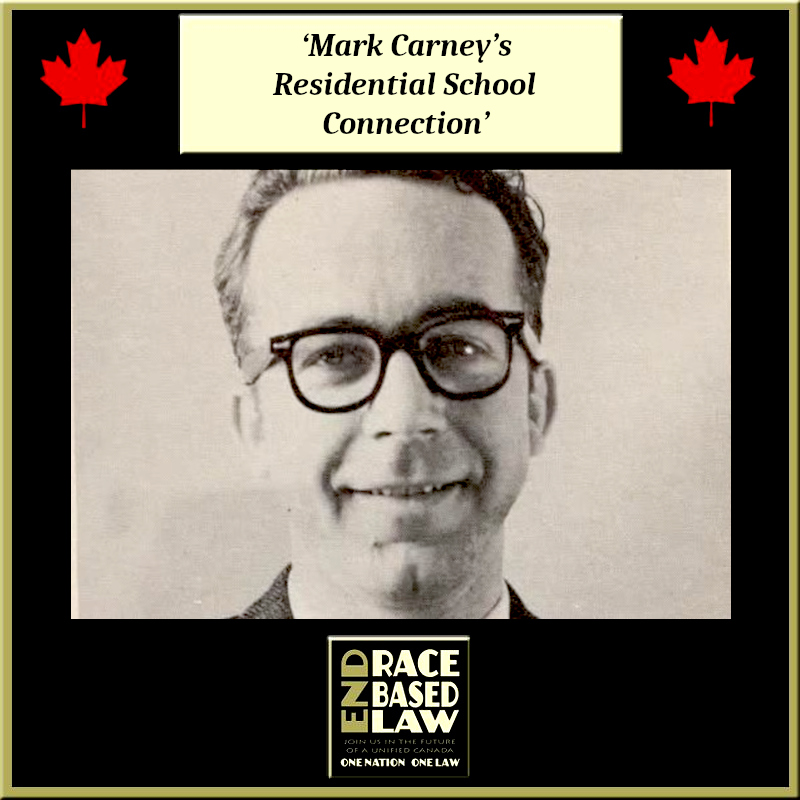
“‘Liberal’ {Party} Leader Mark Carney distanced himself from comments his late father made 60 years ago as an educator that were dismissive of some ‘Indigenous’ {sic, Aboriginal} people, and his subsequent defence of residential schools in the later years of his life.
“Some have criticized me for stating that the good, as well as the bad, of residential schools should be recognized. I stand by that statement. Others have criticized me for stating that the Truth and Reconciliation report was not as balanced as it should be. I stand by that statement as well. And finally, I have been criticized for offering concerned Canadians a space to comment critically about the ‘Indian Act’. My statements and the resulting posts were never meant to offend anyone, and I continue to believe that ‘Indigenous’ issues are so important to all of us, that a frank and honest conversation about them is vital.”
“Lynn Beyak, the controversial Senator from northwestern Ontario with a long history of making inflammatory remarks about ‘Indigenous’ {sic} peoples {Leading with an unsupported editorial comment from a supposed ‘journalist’ – typical CBC}, is resigning from the Red Chamber.
“A book can be understood more deeply by knowing a little about its authors and historical context. Both editors, C.P. Champion and Tom Flanagan, are members of the Indian Residential School Research Group (IRSRG), as are most of the authors of its sixteen essays, among them retired judges, lawyers, professors, and journalists.
“All members of the IRSRG agree on the main point of ‘Grave Error’,
“that no persuasive evidence has yet been offered by anyone for the existence of unmarked graves, missing children, murder, or genocide in residential schools”.
‘How The Aboriginal Industry Wins In Court’ {September 16, 2015}:
“In Indian treaty rights cases, the standards of evidence and logic are not what they are elsewhere… In these trials by history (i.e, law office history), watching the highly-skilled, forceful attorneys at work serving the Indian cause was a thoroughly eye-opening experience. From them, I learned much about the selective use — and suppression of — historical and anthropological evidence…”
‘Deconstructing The Aboriginal Industry’ (June 2, 2016):
“Canada spends billions on its native people, yet many aboriginals remain plagued by poverty, addiction and other social ills. Meanwhile, a handful of lawyers, Band leaders and chiefs prosper…”
‘WHY DOES IT GARNER SO MUCH FEAR….?’ (Michele Tittler) {June 20, 2015}:
“Aside from race laws in our constitution, the Indian Act needs to be abolished, and so many of the aboriginals feel the same way about it, so why are we not all doing this together? Them included.
“Why can’t we END RACE BASED LAW, abolish the Indian Act, and stop feeding the Indian Industry?”
‘What Happened To Legal Equality?’ (Gladue) {Apr.4, 2024}:
“In attempting to cope with the high proportion of aboriginals in Canadian prisons, Parliament and our judicial leadership have unfortunately resorted to differential treatment based on race/heritage. It’s called ‘Gladue’, after the name of the Supreme Court case. The Court, instead of doing its duty and tossing out the discriminatory legislation, sided with ‘aboriginal exceptionalism’, and extended Segregation into court sentencing…”
‘ON USING THE TERM ‘INDIAN’’ (Peter Best) {June 20, 2015}:
“Indian” is the precise, legal and denotative term for what is in fact a purely race-based legal category of persons in Canada. It’s in the title of the ‘Indian Act’ and used throughout that statute. It’s in the Constitution of our country, referring to that class of aboriginals who inhabit southern Canada. (The other two legally defined types of aboriginals in the Constitution are “Inuit” and “Metis”.)
“If the reader feels uncomfortable seeing and reading the word everywhere because it “sounds racist”, then good! That’s the point — it is inherently racist! And as such, it’s inherently wrong that it’s in our Constitution, statutes and court decisions.
“Canada’s ultimate goal in this regard should be for us all to have no need or desire to have the word “Indian” in our Constitution, in any of our statutes, or to be a meaningful legal term generally…”







 END RACE BASED LAW inc. Canada FEATURE STORIES